Five studies in progress: models, hardware and planned validation.
September 2026 working manuscripts. Acceptance and publication status have not been verified.
Conceptual diagram · Separated stages and changing attitude Not a measured result or a drawing of the built vehicle.
Research team 1
Motion after stage separation
The team studies post-separation attitude changes to inform autonomous ignition decisions.
Current evidenced stage
Prototype and preliminary simulation; ground initial-condition tests are ongoing. Autonomous multistage flight and an operational safety envelope have not been validated.
Method and next validation
Method
A mechanical separation prototype and ground tests inform the uncertain initial conditions of a reduced-order, six-degree-of-freedom model. Quaternion attitude representation and Barrowman aerodynamics describe the motion; Monte Carlo simulations explore how differences at separation affect the subsequent trajectory. Preliminary simulation identifies tilt as a candidate indicator for distinguishing conditions.
Next validation
Refine the model with ground-test observations, assess the decision boundary across uncertain conditions, and develop the onboard decision logic. These remain research and validation tasks.
Working manuscript title
단 분리 로켓의 과도 동역학 기반 점화 안전 한계선 정의 및 자율 점화 시스템 개발
Definition of Ignition Safety Envelope Based on Transient Dynamics of Stage Separation Rockets and Development of Autonomous Ignition System
Conceptual diagram · Vehicle, disturbances and landing target Not a measured result or a drawing of the built vehicle.
Research team 2
Learning-assisted precision landing
A conventional landing controller with bounded learned corrections for wind, sensing delays and target uncertainty.
Current evidenced stage
Simulation feasibility study. Some disturbed conditions show a small improvement trend, but statistical significance is not established. Physical landing performance is not yet validated.
Method and next validation
Method
A PD velocity controller is paired with a Proximal Policy Optimization (PPO) policy that supplies residual velocity corrections. Matched Monte Carlo simulations compare baseline and residual control under nominal, delay, target, wind and mixed conditions, including sensor noise and dropout. The paired evaluation helps distinguish a controller change from differences in the simulated scenarios.
Next validation
Increase the number of evaluation episodes and test how the combined controller transfers to PX4-based real-flight experiments. Simulation results are a starting point, not a completed flight demonstration.
Working manuscript title
PPO 기반 잔차 제어를 이용한 무인항공기의 강건한 정밀 착륙 기법
Robust Precision Landing of an Unmanned Aerial Vehicle Using PPO-Based Residual Control
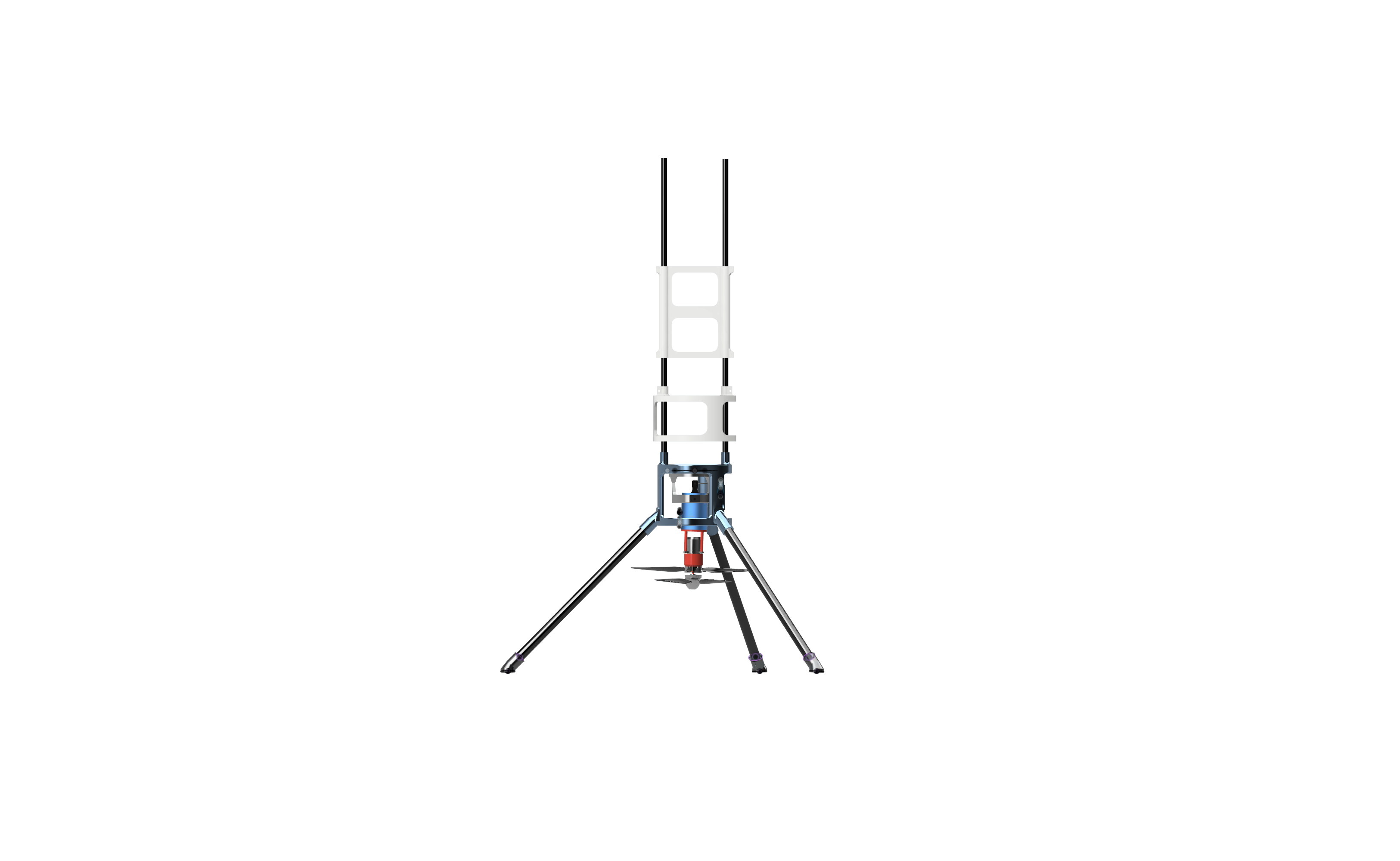
Electric TVC testbed CAD. A hardware design view, not proof of free flight.
Research team 3
An electric thrust-vectoring testbed
An electric testbed for studying thrust-vector control, attitude and altitude response.
Current evidenced stage
Hardware built and experimentally characterised; control response studied in simulation. Free-flight vertical takeoff and landing have not yet been demonstrated.
Method and next validation
Method
The built testbed combines coaxial counter-rotating propellers with a two-axis gimbal. A Pixhawk 6C running PX4 communicates with a Raspberry Pi 5 through uXRCE-DDS. Measured propulsion, actuator and mass characteristics feed a nonlinear six-degree-of-freedom simulator, where cascaded PID controllers are studied for attitude and altitude response.
Next validation
Validate takeoff, hover and descent in free flight. Model-predictive control and convex-optimisation guidance are later research directions, not capabilities established by the current results.
Working manuscript title
재사용 발사체 기술 개발을 위한 전기식 TVC 수직이착륙 시연체의 개발 및 제어
Development and Control of an Electric TVC VTVL Testbed for RLV Technology
Conceptual diagram · Annular passage and distributed flow Not a measured result or a drawing of the built vehicle.
Research team 4
Uniform flow through an annular injector
An annular swirl injector model for even oxidiser distribution across end-burning hybrid fuel.
Current evidenced stage
Design model and CFD study; experimental validation is pending. “120 N” names the reference design class, not measured thrust from this study.
Method and next validation
Method
A coupled model connects injector geometry and hydraulics with fuel regression and motor performance to narrow the feasible designs. Steady, single-phase RANS simulations with an SST turbulence model then examine the flow, using area-weighted mass-flux uniformity to compare candidate designs.
Next validation
Compare the model with PLIF cold-flow measurements and subsequent hot-fire validation. Simulated flow uniformity must still be tested against physical measurements.
Working manuscript title
120 N급 End-burning 하이브리드 로켓용 환형 스월 인젝터의 설계 모델
Annular Swirl Injector Design Model for a 120 N End-burning Hybrid Rocket
Conceptual diagram · Four independent control surfaces Not a measured result or a drawing of the built vehicle.
Research team 5
Tail-fin attitude control
Gain-scheduled PID control of four independent tail fins under changing flight conditions.
Current evidenced stage
Actuation prototype and basic digital-twin architecture. Hardware-in-the-loop and flight validation are not complete; no quantified control-performance gain is established.
Method and next validation
Method
A mechanical actuation prototype is paired with a MATLAB/Simulink six-degree-of-freedom digital twin. CAD and OpenRocket inform inertia and stability, while actuator limits and delays are represented in the model. Prototype checks examine fit and mechanical play; the simulation architecture defines how the controller will be evaluated.
Next validation
Refine aerodynamic coefficients through CFD, identify actuator response, complete the gain schedule and run disturbance simulations. Ground integration and a later flight test form the planned validation path.
Working manuscript title
게인 스케줄링 PID 제어를 이용한 아음속 사운딩 로켓의 테일핀 제어 시스템 개발
Development of a Tail-Fin Control System for a Subsonic Sounding Rocket Using Gain-Scheduled PID Control